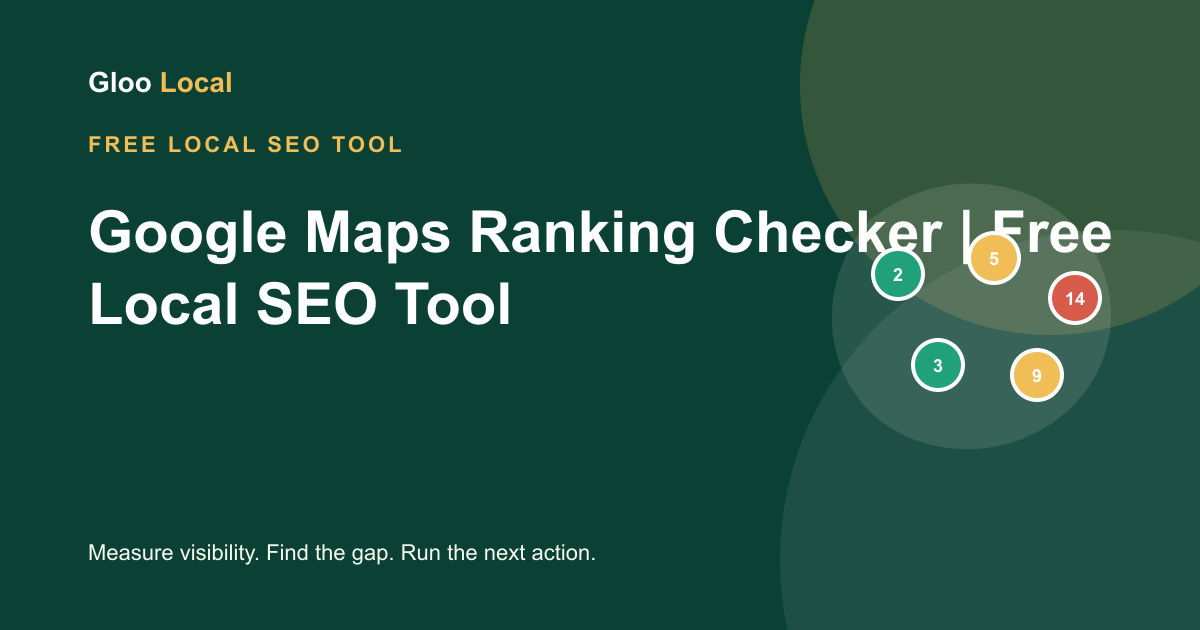
A Google Maps geo-grid repeats the same search from multiple coordinates around a business. Read the shape of top-three, top-ten and missing pins; identify which competitors recur; then connect the pattern to relevance, distance, prominence and the evidence customers can inspect.
If you check your ranking while standing inside your business, Google knows exactly where you are. That single search can make a business look stronger than it is across the neighbourhood. A customer three kilometres away, on the other side of a road, suburb or competing cluster, may see an entirely different local pack.
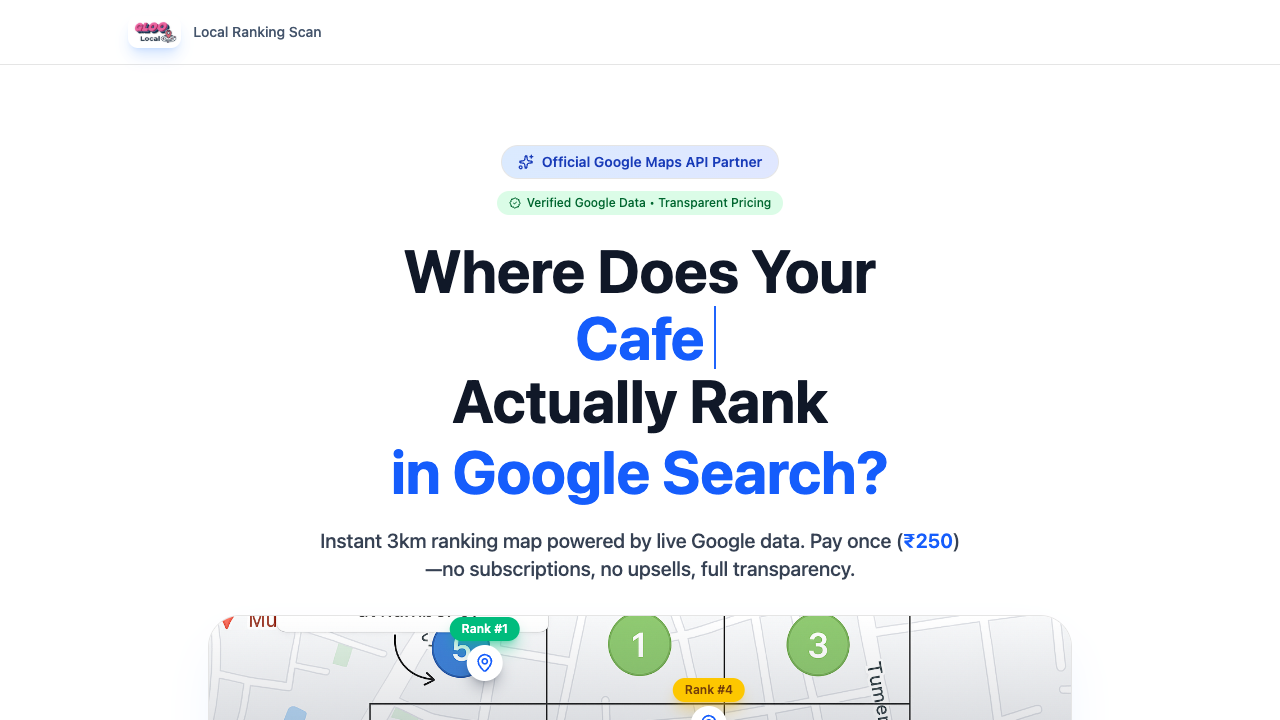
That is why Gloo Local scans the same keyword from a defined set of coordinates around the location. The result is not one flattering number. It is a visibility surface: a field of ranked pins showing where the business is dominant, vulnerable, weak or absent.
What every pin is actually telling you
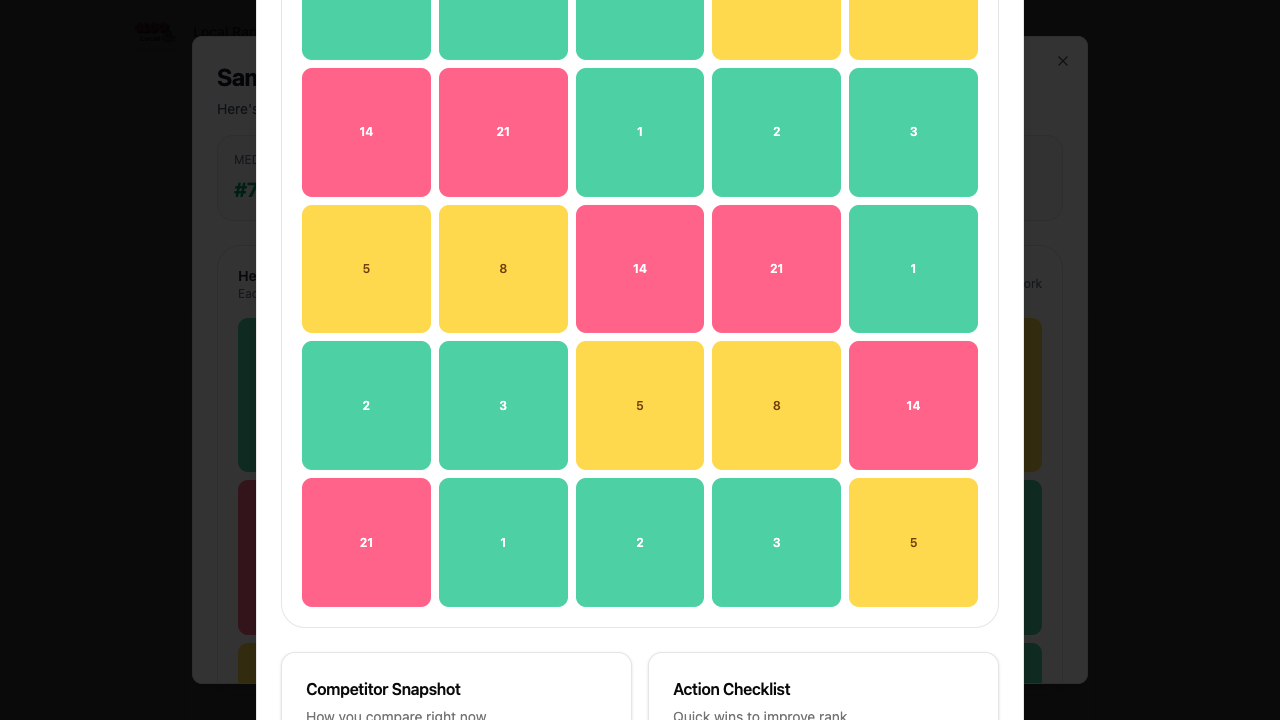
Each pin represents one simulated search location. The number is the business's position in the local results observed at that coordinate for the selected keyword. The centre marker is the target business location; it is not automatically the strongest point.
Green pins answer one question: where is the business currently strong enough to enter the local pack? Amber pins show visibility without security. Coral and grey pins show where customers are likely to meet competitors first.
The shape matters more than the prettiest pin.
Read distance decay, asymmetry and holes
Local visibility normally weakens as the searcher moves away, because distance is one of Google's stated local-ranking considerations. But distance alone does not explain every pattern. Google says local results are mainly based on relevance, distance and prominence, which means the shape must be interpreted with the business, query and competitive market in view.
A compact green centre with rapid decay
The business is discoverable near its premises but loses quickly across the catchment. Check whether the keyword represents a service, product or treatment that the profile and website explain clearly. Then inspect which competitors take over outside the centre.
A strong grid with one weak direction
An asymmetrical gap can reflect roads, neighbourhood boundaries, a competitor cluster, service-area reality or how Google understands the business relative to that side of the market. Do not average the gap away. Annotate it and investigate the recurring winners.
Random holes inside otherwise strong coverage
First confirm that the scan method, grid and keyword were stable. If the hole repeats, compare the local pack at those coordinates. A one-off missing pin is noise; a recurring geographic pocket is an operating question.
Your real competitor changes with the query
A restaurant searching its brand name may appear dominant while losing “family restaurant,” a signature dish, a cuisine or an occasion query. A salon can win “salon near me” and disappear for bridal makeup or hair colour. A dental clinic can face a different top three for implants, braces, emergency dentistry and root canal treatment.
Gloo Local therefore treats competitor frequency as part of the report. The useful competitor is not simply the nearest business or the brand named in a strategy meeting. It is the business that repeatedly appears above you for a valuable customer intent across the coordinates that matter.
| Pattern | What it may indicate | What to inspect next |
|---|---|---|
| One competitor dominates most pins | Broad relevance or prominence advantage | Categories, services, review depth, website evidence and local authority |
| Different winners by neighbourhood | Catchment-specific competitive markets | Branch ownership, distance bands and neighbourhood intent |
| You win generic intent but lose valuable services | Weak service-level relevance | Profile services, dedicated pages, proof, FAQs and customer language |
| Your own branches appear against each other | Location overlap or unclear ownership | Keyword-location assignment, branch pages and catchment strategy |
A scan without an action is just expensive colouring
Gloo Local is built to carry the report into the next operating action. A relevance gap may become a Google Business Profile update, a stronger service or treatment page, a review-informed FAQ, a local post or a better piece of visual proof. A reputation gap may become a response queue and an escalation for a repeated customer issue. A stale-content gap may become an Instagram and GBP programme grounded in the same keyword and review evidence.
Compare the same market twice
Never call a ranking change from two incompatible scans. Keep the target business, keyword, grid size, radius, search method and observation cadence stable. Retain pins that improve, decline, appear for the first time or disappear. A summary that silently removes missing rows overstates success.
Also separate three states: the action was completed, Google accepted or surfaced the changed information, and visibility moved. They can happen at different times. The goal is not to force a story onto every fluctuation; it is to build a repeatable operating cycle that makes meaningful movement visible.
External evidence behind the field guide
- 01Google Business Profile: tips to improve local ranking
Google's description of relevance, distance and prominence, plus profile, review and media guidance. - 02BrightLocal Local Consumer Review Survey 2026
Representative US consumer research on review usage, recency, volume and rating expectations. - 03Gloo Local Maps visibility benchmark methodology
Definitions for grid coverage, distance bands, competitor share and comparable observations.